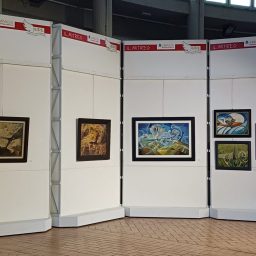
Travelling exhibition featuring international artists: ‘Dimensioni Incrociate/Crossed Dimension’, curated by Katarzyna Ziołowicz and Arkadiusz Sędek.
Artists: Fabio Massimo Caruso (IT), Wojciech Domagalski (PL), Patrizia D’Orazio (IT), Anita Grobelak (PL), Jakub Matys (PL), Monica Melani (IT), Magda Milano (IT), Yener Pınarbaş (TR), Michel Pochet (FR), Arkadiusz Sędek (PL), Teresa Anna Ślusarek (PL), Grazia Tagliente (IT), Rafał Urbański (PL), Katarzyna Ziołowicz (PL).
Dates and venues:
Konduktorownia Gallery – Częstochowa (Poland) from 12 to 29 August 2026 – closing event
University Gallery of the UJK Library in Kielce (Poland) from 1 September to 14 October 2026 – closing event
Mitreo-Arte Contemporanea Gallery in Rome (Italy) from 24 October – opening – to 24 November 2026 (https://www.mitreoiside.com/)
Gallery of the Academy of Fine Arts in Bari (Italy) – from 27 November – opening – to 12 December 2026.
‘Crossed Dimensions’ is an artistic-scientific project that is not limited to presenting a specific theme, but seeks to capture creative strategies based on transcending the boundaries of the medium of expression, the discipline and individual experience. The project’s title also serves as its interpretative framework: dimensions can be understood as spheres where different orders of reality interpenetrate, in which the material meets the spiritual, individual experience is embedded within a broader cultural context, and the past remains present in the present.
These are not, therefore, parallel dimensions, isolated from one another. On the contrary: they intersect, overlap and influence one another, creating a dynamic field of meanings. Contemporary man operates simultaneously within multiple realities: material and symbolic, personal and social, real and virtual. Art becomes one of the spaces in which these different spheres can be brought into dialogue, become the subject of reflection and, at times, be integrated. Fourteen artists from Poland, France, Italy and Turkey, representing diverse cultural traditions, experiences and approaches to art, have responded to the invitation to take part in the project.
The aim of the project is to compare different artistic approaches and individual ways of interpreting the material and spiritual world, as well as social relationships viewed from a historical and symbolic perspective. The variety of approaches presented demonstrates that contemporary art cannot be reduced to a single formula. Alongside the mimetic language used to interpret reality, there coexist abstraction, expressiveness, conceptual practices, generative art, photography, experimental graphic design and actions straddling the boundary between painting and performance. In many works, the symbol is not an incidental element of the image, but a fundamental tool for the construction of meaning. This variety of artistic forms and languages does not, however, lead to the fragmentation of a shared narrative. On the contrary, it reveals the possibility of a dialogue between different ways of perceiving the world.
The material dimension
The first dimension examined is the material one — linked to material culture, the object, structure, the traces of human labour, technology and the properties of the material itself. Here, the material does not appear as a neutral medium for ideas, but becomes an active participant in the creative process, endowed with its own memory, history and cultural meanings.
In Grazia Tagliente’s works, the materiality of the medium is intertwined with the observation of nature. Fascinated by the possibilities offered by traditional printmaking, the artist employs structural printing using natural matrices, reproduced on cotton paper. The precision of the technical process takes on an almost ritualistic character, whilst the act of working in harmony with nature becomes an integral part of the composition. The leaf motif — a symbol of growth, renewal and life — is given a personal interpretation by the artist. Its delicacy and openwork structure, as well as its vulnerability to the wind, reveal the paradoxical relationship between fragility and strength. Here, nature becomes not so much an object of representation as a space for reflection on the cycle of life and death.
Anita Grobelak constructs her canvases through the texture of the paint and the intensity of colour. Her stories lie on the border between reality and dreams, giving rise to fantastical narratives in which the memory of historical events is reworked by the imagination. The texture of the image serves not only as a means of representation: it becomes a way of preserving memory, transforming it and reliving it.
We find a different dimension of materiality in the works of Jakub Matys, whose practice lies within the field of generative art. The artist translates mathematical models into the language of visual forms, focusing on ‘forms that exist outside the space we can directly see and experience’. The concept becomes the starting point for a process in which an abstract model is translated into a physical object. The generated forms, 3D printing and a distinctive graphic style employing a three-dimensional mould give rise to a composition in which mathematical, digital and material order converge. This is an emblematic example of the intersection between these dimensions: the form that arises outside direct sensory experience is ultimately transformed into a concrete, tangible object.
Patrizia D’Orazio, drawing on traditional intaglio printing techniques — etching and aquatint — analyses systems of lines, dots and planes. These graphic contrasts enable her to construct abstract compositions in which one can discern echoes of ephemeral spaces, industrial landscapes or fragments of everyday life reduced to elementary geometric forms. Traditional printmaking techniques, however, do not constitute a limitation, but rather a tool of the contemporary language of abstraction.
The spiritual dimension
The second sphere is constituted by the spiritual dimension — the realm of introspection, memory, symbolism and transcendence. It refers both to spiritual culture, belief systems, myths and rituals, and to the most intimate experiences: the search for meaning, loss, hope, nostalgia or the need for contemplation.
In artistic practice, this dimension often manifests itself through metaphor, allusion and the poetics of form. The image does not convey a single, unambiguous message, but creates a space in which the viewer can engage with their own experience.
Fabio Massimo Caruso refers to the eternal quest for a link between the earthly and the perfect — implicitly the divine. The form of the altar used by the artist becomes an attempt to symbolically unite these two worlds. Of particular importance here is the circle — a perfect, closed shape, with no beginning and no end. The work is not merely an object of contemplation, but an invitation to an intimate encounter with its essence.
In Katarzyna Ziołowicz’s drawings, the symbol becomes a tool for exploring the invisible links between the material and spiritual worlds. The motif of song serves as an ephemeral and immaterial sign of contact — a longing for what is no longer there, for people who have passed away and for moments we hold only in our memories. The drawing thus becomes a testimony to absence and, at the same time, an attempt to evoke it through the image.
Magda Milano explores the question of the meaning of one’s earthly journey. Her work, described by the artist as a ‘manifesto of nihilism’, stems from her existential condition. The delicacy of the formal means employed creates an interesting tension with the gravity of the subject matter. The artist’s image merges with the forms of nature, offering a further interpretation of the eternal question regarding the meaning of existence and the cyclical nature of life.
In Michel Pochet’s work, the coastal landscape becomes a space of nostalgia and spiritual experience. A vast expanse of blue, a symbolic face and small linear marks suggesting a human presence construct an image steeped in silence. The majesty of nature ultimately overshadows humankind, becoming almost the embodiment of the Creator. The seashore at night is transformed into the artist’s personal sanctuary — a place of contemplation, but also of coming to terms with one’s own solitude.
For years, Monica Melani / MelAjna’s artistic practice has focused on metaphysical compositions created using an original painting technique that straddles the boundary between expressive abstraction and performance. The essence of this approach lies in unleashing emotions through the free flow of colours across the surface of the water. The creative process becomes an experience of purification that evokes the function of art known since ancient times: the possibility of transcending everyday experience and, for a fleeting moment, touching the realm of the sacred.
The relational-temporal dimension
The third dimension — the relational-temporal one — encompasses the area where the past, present and future projections intersect. It is the space of relationships between the individual and the community, personal and collective memory, tradition and the contemporary. In this dimension, the work of art becomes a place for the negotiation of meanings, where different narratives, experiences and ways of understanding reality converge.
Wojtek Domagalski explores the theme of historical memory through the medium of photography. On the one hand, photography appears as a dispassionate record of a specific moment; on the other, it is a document capable of preserving emotions and stories that can be understood above all by those connected to the people and events depicted. The use of silver emulsion transforms the photograph into a sort of enigma, a visual puzzle whose meaning is not immediately revealed. The image becomes a vehicle for family memory: the people portrayed are no longer with us and cannot tell their story, yet their presence nourishes a sense of continuity in existence.
Arkadiusz Sędek adopts a different strategy, analysing the issue of contemporary identity. Unlike Domagalski’s documentary approach, Sędek focuses not so much on preserving traces of the past as on exploring the boundary between truth and fiction. What does the contemporary individual wish to reveal and what to conceal? To what extent does the image they construct represent their true ‘self’, and to what extent is it the result of a narrative intended for others? Here, identity becomes a construct subject to constant negotiation.
Yener Pinarbaş also reflects on the human condition and its temporary presence in the world. The artist uses sunlight to imprint three-dimensional images of people onto the surface of fabric, creating dreamlike, two-dimensional portraits. Prolonged exposure causes the fabric to fade, leaving an imprint on the surface that is both a trace of presence and a testament to the passing of time. The technological process becomes a metaphor for time: the image is generated precisely through the gradual transformation of the material.
Rafał Urbański, in turn, explores the theme of the contemporary human condition, contrasting the real world with the virtual one. The artist highlights the consequences of this dualism, which allows people to create fictitious identities and navigate an information space whose veracity remains difficult to verify. In this context, the use of symbolism borrowed from Baroque painting is particularly interesting. The skull motif, which draws on the tradition of vanitas, serves as a reminder of the transience and fragility of existence — values that easily lose their tangibility in virtual reality.
Teresa Anna Ślusarek transports the viewer into a universe of fantastical cybernetic forms, created using an original graphic technique. Her works open up the possibility of venturing into unknown spaces and embarking on imaginary journeys. The industrial character of the objects blends with biological elements, giving rise to hybrids halfway between nature and technology. Time here is not merely a chronological category, but becomes a space of transition where past, present and future coexist.
Intersections
The combination of these very different practices demonstrates that ‘Crossed Dimensions’ is not an exhibition defined by a single shared aesthetic. Its coherence does not stem from the similarity of forms, but from the tensions between different ways of understanding reality. Traditional graphic design meets 3D printing and generative art; documentary photography clashes with the construction of identity; the landscape is transformed into a metaphysical space for contemplation, whilst matter becomes a trace of memory.
The interdisciplinary nature of the project is revealed precisely at these points of intersection — where the language of the visual arts engages in dialogue with science, philosophy, anthropology, technology or personal experience. It is not a matter of compiling a catalogue of disparate practices, but of showing how contemporary art develops by transcending boundaries and forging new connections between seemingly distant fields.
In this sense, ‘Crossed Dimensions’ is not merely the title of the project, but its very methodology. Each of the works on display constitutes an attempt to find its own place between the visible and the invisible, the material and the spiritual, the personal and the collective, the real and the imaginary. Ultimately, the coming together of artists from different backgrounds demonstrates that diversity does not necessarily lead to isolation, but can spark a profound dialogue.
The contemporary world, which is becoming increasingly homogenised, has an urgent need for such spaces of encounter. Art does not resolve existing divisions, but enables us to see them, name them and experience them with a fresh perspective. It becomes a space for negotiating meanings and a tool for communication that transcends linguistic, geographical and cultural boundaries.
‘Crossed Dimensions’ therefore leaves the viewer not so much with an answer as with a question about their own place amongst these worlds. For it is perhaps precisely at the exact point where they intersect — between matter and spirit, memory and the present, reality and imagination — that the experience of contemporary humanity is preserved.

Post
Story
Whatsapp