
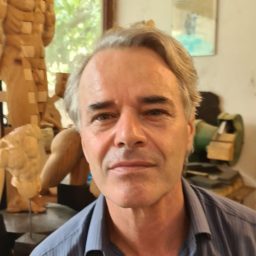
Sculptor Paolo Frattari, enclosed within a glass room, continues his live performance. Separated from yet exposed to the public gaze, he works ceaselessly on his sculpture. Using a chisel, he refines Corpus—his wooden creation—working the material with precise, repetitive, and patient movements.
The glass room thus becomes a suspended space—a place of work, but also of observation. Elements that normally belong to the private realm of the studio are brought into view: the creative process, the physical exertion, the concentration, and the tangible relationship between artist and material.
Sculpting is an ancient act through which humanity has sought to transform matter and leave a mark. When sculpting wood, one cuts, carves, and removes material to reveal a form. Every strike of the chisel alters the surface, leaving a trace. The sculpture thus emerges slowly, born of listening, control, and intuition.
In this performance, the act of sculpting itself becomes the artwork. The audience enters the timeframe of its creation, witnessing the artist at work—making decisions, altering and refining the material. The final result—the artwork—is inseparable from the process that brought it into being.
The glass room acts as a barrier that separates yet reveals. The creative act passes through the glass to reach the audience, becoming the very heart of the work. One observes not only the emerging wooden creature but also the man transforming it.
Paolo Frattari thus becomes part of his own work. His body, his presence, his manual skill, the rhythm of the chisel strikes, and his physical connection to the wood all form part of the installation.
Corpus exists in a state of constant transformation; as long as the artist continues to sculpt, the work is never truly finished. Each intervention opens up a new possibility; every strike of the chisel alters what existed before.
The installation is the sculptor himself in the act of creating.

Post
Story
Whatsapp