
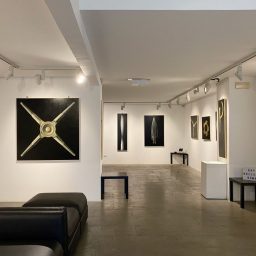
Kou Gallery presents Heterotopias, a two-person exhibition featuring Margherita Cerioni and Abel Montefalchi, conceived to bring into dialogue two complex and introspective bodies of work that together outline a dualism that is, at times, complementary. Cerioni’s research unfolds through perspectives that evoke the celestial and the cosmic, while Montefalchi’s is rooted in an earthly, tangible dimension, connected to the changing nature of human skin.
The title explicitly refers to the thought of Michel Foucault and his reflection on the relationship between utopia and heterotopia, understood as its symmetrical inverse. Through this concept, the philosopher identifies real places that open onto other places, establishing relationships of overlapping, reflection and discontinuity with the surrounding space. The mirror is the quintessential heterotopia: within it, we see ourselves where we are not, in an unreal space that opens virtually behind the reflective surface, while simultaneously constituting a real place connected to the space around it.
The exhibition seeks to establish a relationship between the suspended and unrepeatable spaces into which the artists invite us, without this opening ever implying an escape from reality. While utopias refer to places without an actual physical location, heterotopias emerge as real spaces capable of establishing alternative relationships with the world, where perception is redefined and the boundaries between seemingly distant dimensions become permeable.
Both artists direct their research towards the human condition, recognising humanity as a geological force capable of irreversibly transforming the surrounding reality. Their works investigate the traces of this transformation, revealing the layers through which body and landscape leave their imprints upon one another.
While Cerioni directs her gaze vertically towards the suggestion of a sky that offers the possibility of abstraction, discovering in the deterioration of Rome’s urban ground a kind of asterism capable of attracting and disorienting the viewer, Montefalchi focuses on a horizontal exploration of matter, challenging perception through the tangible superimposition of details of his own skin and natural landscapes.
These two distinct trajectories, although moving in opposite directions, converge in their ability to reveal a constantly changing reality, in which the experience of the body and that of space reflect and continually redefine one another.

Post
Story
Whatsapp