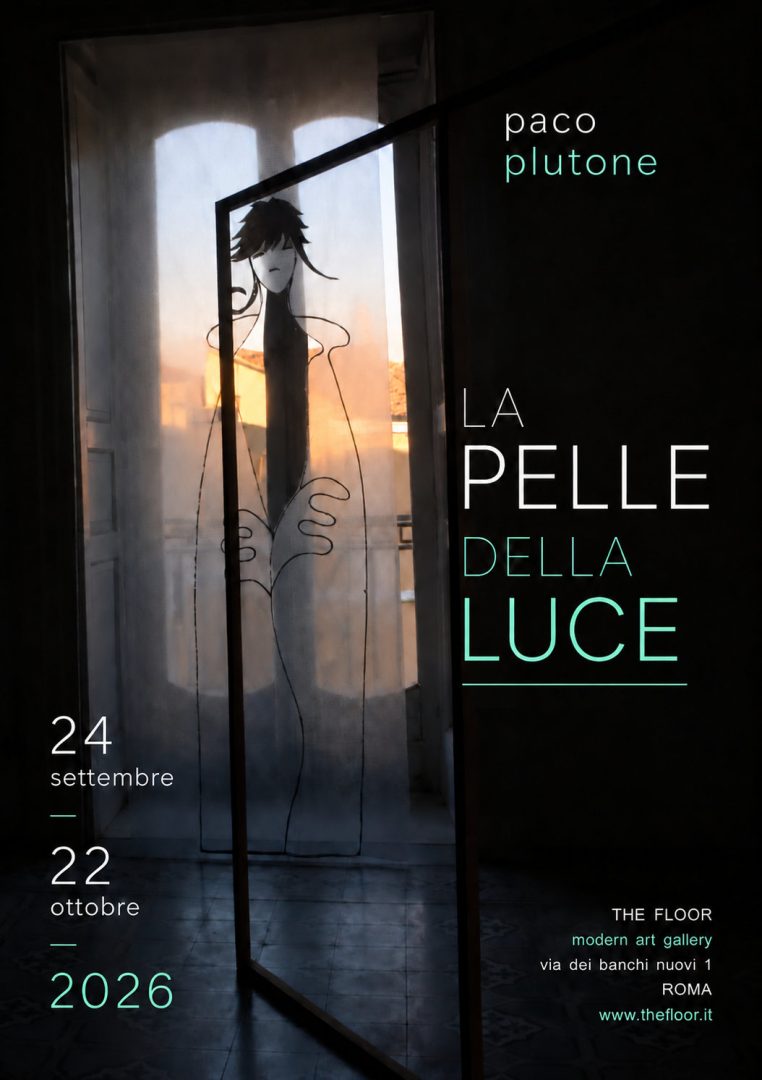
In The Skin of Light, Paco Plutone pushes painting beyond the conventional boundaries of the pictorial surface, allowing transparency, light and space to become active elements in the making of the image. Rather than simply occupying the exhibition space, the works absorb it, open themselves to it and ultimately reshape it.
The artist’s large, predominantly female figures—elongated, monumental and yet strangely fragile—emerge across transparent and semi-transparent industrial materials. Surfaces originally intended to protect, divide or contain are stripped of their practical purpose and turned into pictorial membranes. The support is no longer a background. It becomes a threshold.
And it is through this threshold that light enters the work. Passing through the material and interacting with colour, light alters its density, casts shadows and projections, reveals the reverse of the painted surface and draws whatever lies beyond it into the image. Walls, architectural details, neighbouring works and passing bodies become temporary elements within the composition. The distinction between image and background begins to collapse, allowing the surrounding world to enter the work. The surface takes on a physical presence and painting begins to operate almost as sculpture—not by acquiring mass, but by occupying space.
The viewer is inevitably drawn into this process. There is no single or definitive vantage point. As we move closer, step back or shift sideways, the image continually assembles and disperses: figures emerge, overlap, fade and return. Transparency, paradoxically, does not make them easier to read. These bodies allow the gaze to pass through them while resisting any attempt to possess them fully. Colour, too, is more than descriptive: it creates distance, interruption, depth and moments of sudden appearance. Colour does not simply mean; it acts.
The female figure lies at the heart of Plutone’s work without ever becoming narrative. His women do not illustrate stories, nor do they present themselves as characters to be deciphered. They are presences. Their recognisable forms remain constantly on the verge of dissolution, suspended between body and sign, exposure and withdrawal, strength and fragility.
The exhibition’s title holds the paradox at the centre of this research: light has no skin. And yet Plutone seems to search for one in the fragile, permeable surfaces of his works—a boundary where things no longer remain entirely separate. A skin that does not shield the image from the world, but exposes it to it.
A place where, for an instant, light becomes body.

Post
Story
Whatsapp