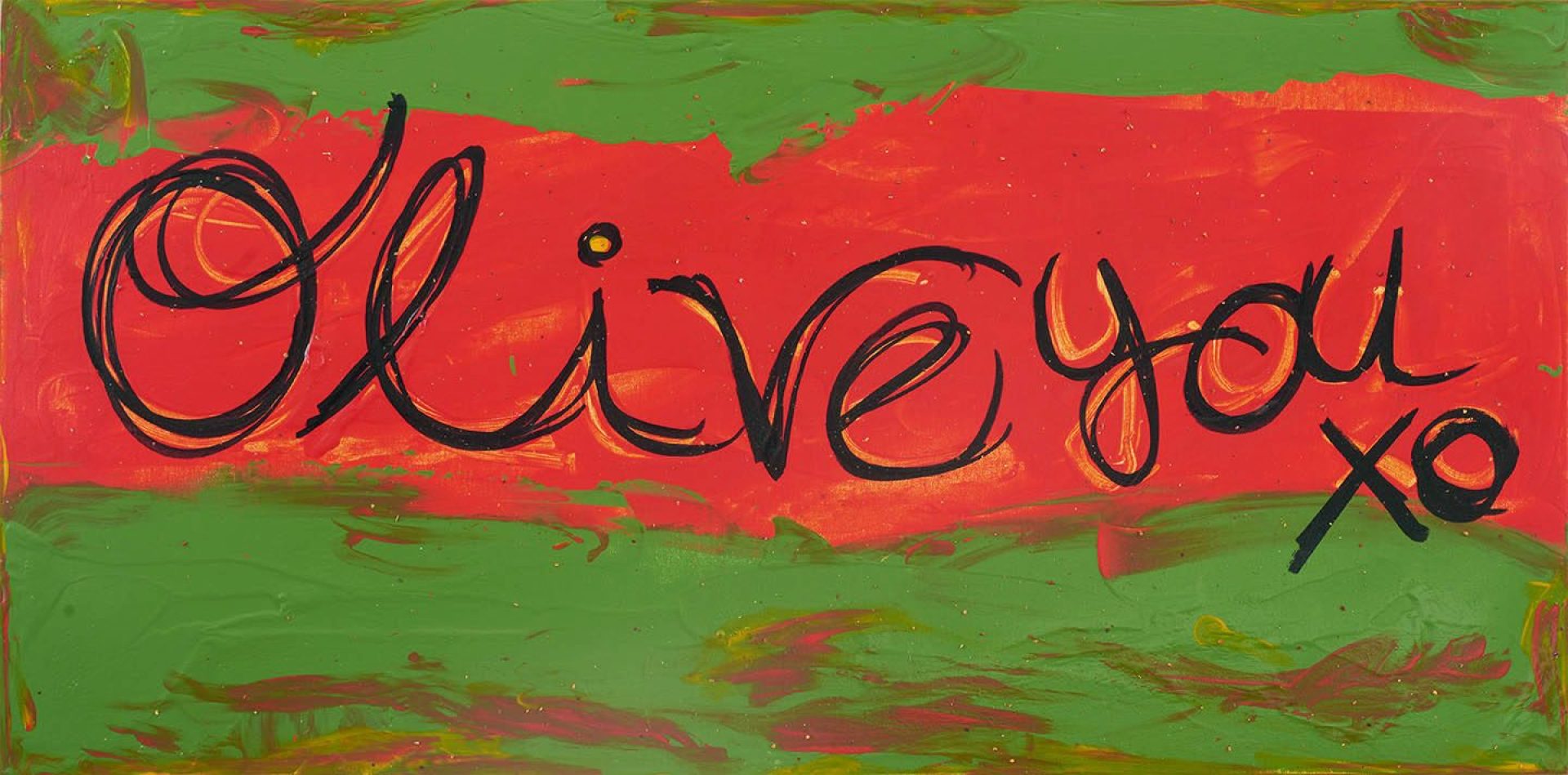
On the occasion of the exhibition Rossocinabro for Peace, to be held on April 24th, the work of American artist Rebeccah Klodt emerges as a powerful and immediate visual manifesto. Through a skillful play on words and a vibrant use of color, Klodt transforms a pictorial surface into a message of hope and reconciliation.
A Message for Peace
The choice of this work to represent Rossocinabro for Peace lies in its ability to break down barriers. In a historical period marked by global tensions, Klodt reminds us that dialogue begins with the simplest gestures. That final "xo" (hugs and kisses) transforms the canvas into a love postcard sent to the world.
The aesthetic of the work, suspended between Abstract Expressionism and textual Pop Art, invites the viewer not to remain a passive observer, but to become a participant in this act of collective kindness.
"In a world that too often chooses conflict, Rebeccah Klodt chooses a declaration of love. 'Olive You' is an invitation to look to the future through the eyes of those who still know how to build bridges of empathy."
Analysis of the Work
Rebeccah Klodt’s work presents itself as a field of chromatic forces. The background is dominated by olive green and cinnabar red—colors that not only reference the name of the gallery and the event but carry deep symbolism.
At the center of the composition, the calligraphic phrase "Olive you xo" dominates the scene. This is a phonetic pun on the English phrase "I love you." This choice is not merely a stylistic whim but a communicative strategy: Klodt uses irony and lightness to convey a fundamental concept. Peace, the artist suggests, is born from the recognition of the "other" through affection and proximity.
“Olive you xo” is not just an exercise in word-art; it fits into a noble pictorial tradition that sees the pairing of text and image as the key to unsettling the viewer's perception.
The rapid, almost feverish gesture with which Klodt traces "Olive you xo" immediately recalls the aesthetic of Cy Twombly. As in Twombly’s work, writing loses its typographic rigidity to become a "living sign." It is not just a phrase to be read, but an energetic path to be traveled by the eye. The layering of black over bright red creates a vibration that transforms the word into urban graffiti—an urgent message appearing on the walls of the collective conscience to invoke peace.
While Robert Indiana, with his iconic LOVE, transformed a feeling into architectural sculpture, Klodt chooses a more intimate and vernacular path. There is an echo of Ed Ruscha’s Pop Art in the use of the pun, where irony serves to make a complex concept accessible. However, while Ruscha often isolates words in aseptic spaces, Klodt immerses them in a chromatic "storm" of red and green, suggesting that love and peace are not abstract concepts, but feelings born from the chaos and fervor of real life.
The use of horizontal bands of color evokes Mark Rothko’s "Color Field Paintings." Yet, unlike Rothko’s contemplative stillness, the application here is tactile and raw, full of drips and overlaps.
The Olive Green framing the work acts as a protective border: it is the color of the earth and military camouflage, but here it sheds its bellicose function to return to being the color of nature and the biblical olive branch.
The Central Red acts as a beating heart or an open wound that is "healed" and sealed by the overlying words of love.
There is an intrinsic generosity in Klodt’s final "xo" that recalls the democratic accessibility of Keith Haring’s art. Just as Haring used universal symbols to speak of life, death, and social love, Klodt uses cursive calligraphy to establish a direct, non-elitist connection with the audience of Rossocinabro for Peace. The work becomes a "visual embrace," an invitation to a truce that uses everyday language to speak of eternal values.
In this canvas, Rebeccah Klodt successfully synthesizes the strength of Abstract Expressionism with the immediacy of contemporary communication. The work does not scream for peace as a dynamic protest, but whispers it as a vital necessity, transforming a simple pun into an act of poetic resistance.
Curated by Cristina Madini